
Vision · Concept
Ediz Hook seawall
Ediz Hook is the long, curving spit that shelters Port Angeles Harbor, the natural harbor that made the town.[14] It carries the road to the Coast Guard Air Station and the Navy's pier, the city's favorite walk, and the harbor's first line of defense from the open Strait.
Third Harvest's concept is to rebuild the Hook's whole north shore as an engineered tsunami seawall that is also a promenade for walking and biking, kept low and green so people still see the water, and carried the full length of the Hook to the tip.
Where this fits in the thousand years: Later step. Protecting the harbor that the rest of the thousand years depends on. See the timeline. What happens between now and then is on us.
- Since 1977
- Years the Army Corps has armored and fed the Hook with rock and gravel[1]
- About 20 feet
- Modeled first tsunami wave at Port Angeles after a Cascadia earthquake[3]
- About 1 hour
- Modeled time from the earthquake to that wave reaching Port Angeles[3]
- Full length
- The concept runs base to tip, including the federal stretch
A spit that already needs help
Ediz Hook was built over thousands of years by gravel washing east from the Elwha River and the bluffs west of town. In the 1900s, the Elwha dams and armoring at the foot of the bluffs cut that supply to a fraction of what it had been, and the Hook began to erode.[1] In 1977 and 1978 the Army Corps of Engineers built a project combining rock revetment and beach nourishment, and further work in 1985 essentially stabilized the spit.[1] The Corps still repairs the revetment and places fresh gravel on the beach.[2]
The Hook is also exposed to the region's largest hazard. Port Angeles lies above the Cascadia Subduction Zone.[4] The Washington Geological Survey's 2022 modeling shows the first rising wave of a Cascadia tsunami reaching Port Angeles in about an hour, with an amplitude of about 20 feet.[3]
The Coast Guard's Air Station Port Angeles sits near the tip,[6] and the Navy opened a pier for submarine escort vessels on the Hook in 2018.[5]
 Concept rendering
A wall you can walk on
ConceptA vegetated, gently sloped seawall along the north shore, built in front of or over the existing Corps rock, with a walk and bike deck on top. It stays low and green, so the Strait stays in view. It runs the full length of the Hook, through the Coast Guard Air Station and the Navy's pier to the tip: the wall protects the bases, and carrying it to the end makes the whole Hook stronger. The harbor side keeps small gravel coves and beaches for people and wildlife.
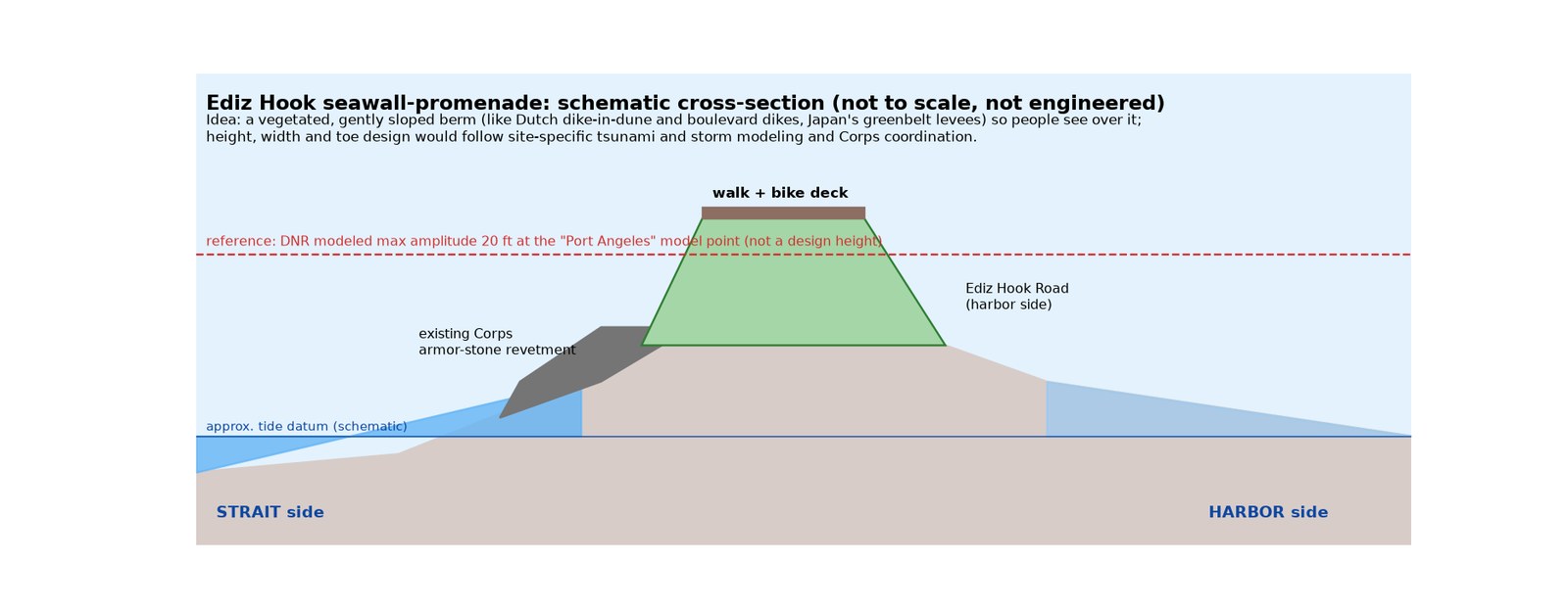
The height, width and toe of the wall would come from site-specific tsunami and storm modeling and from working with the Corps, which maintains the Hook today. FEMA's P-646 guidance covers structures people can climb onto to escape a tsunami,[11] a role a raised, walkable berm could be designed to serve if engineers found it safe.
Sea defenses people already love
- Katwijk, the Netherlands. The town widened its dunes and hid a new dike inside them, with an underground garage for about 670 cars, about 1,640 feet long, between the dike and the boulevard. The wider dunes made more room for nature and recreation.[7, 8]
- Scheveningen, the Netherlands. The water board built a sea wall about 0.6 mile long under a new boulevard designed by the architect Manuel de Solà-Morales, keeping the defense underground and invisible under a seaside promenade.[9]
- Elliott Bay, Seattle. The city's rebuilt seawall has a textured face, rock beds and a light-passing sidewalk for young salmon. Its 2018 monitoring report counted 10,000 juvenile salmon in a single day in May.[10]
Each shows the same idea: a sea defense can be a place people choose to spend time, and it can give habitat back rather than take it.
Where it sits
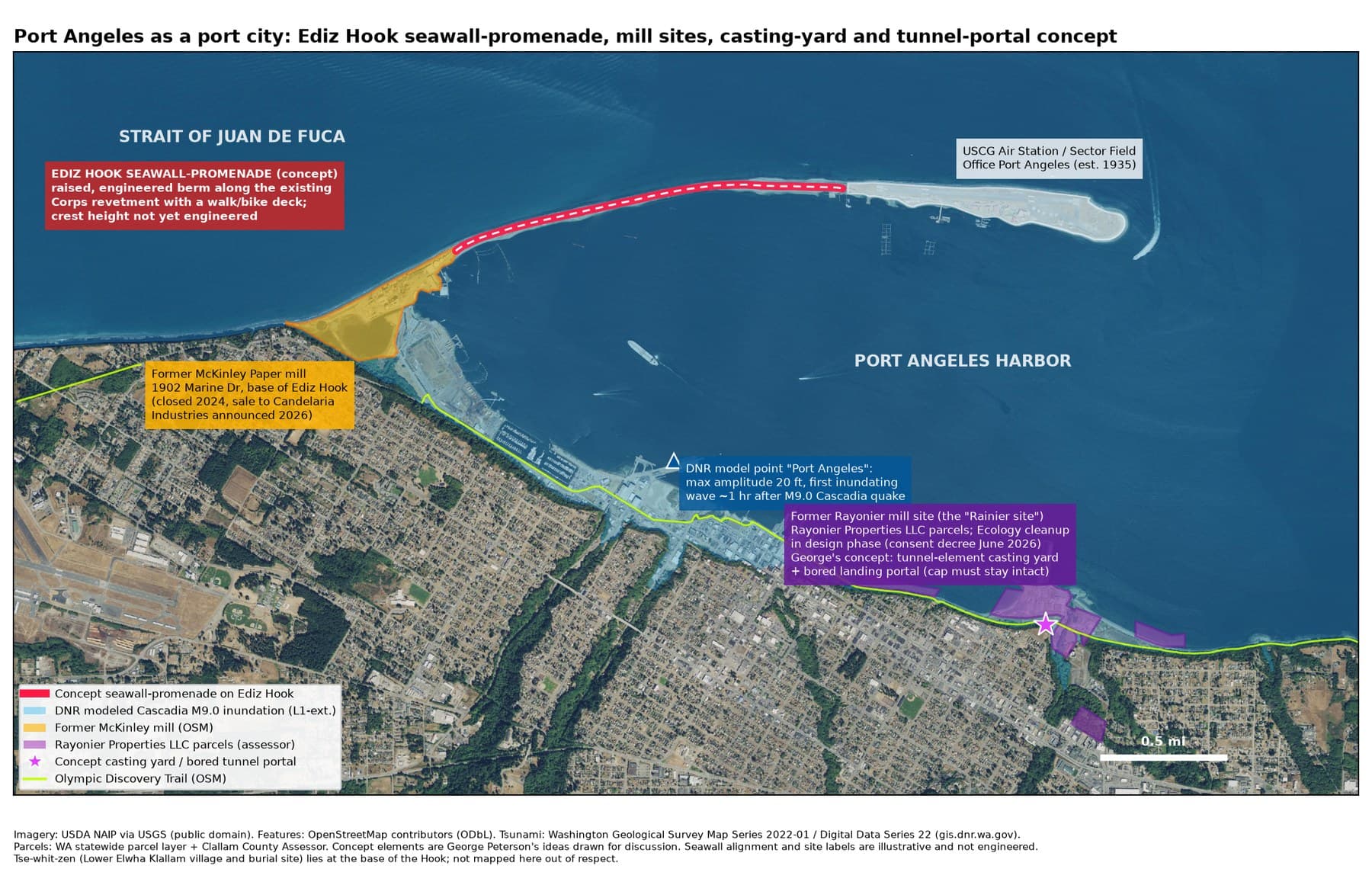
The Hook connects at its base to the former McKinley mill site, where Third Harvest proposes a green waterfront district and a working yard. See Mill site and the Port Angeles tunnel page.
What would have to be true
What would have to be true
- The Lower Elwha Klallam Tribe first. Tse-whit-zen, an ancestral Klallam village and burial ground, lies at the base of the Hook, where the state stopped a construction project in December 2004.[12, 13] Any work on or near the Hook starts with inviting the Tribe to the table.
- Federal agreement for the stretch through the Coast Guard Air Station and the Navy's pier, which is federal land.
- The Corps, the City and the Port agree on what the Hook becomes, with site-specific tsunami modeling setting the wall's height.
- Habitat and permits. Shoreline, fish and wildlife permits, and a design that keeps the beach and drift processes working rather than hardening them further.
- Money. No cost has been estimated. This is a concept, not a funded project.
Nobody has been contacted, and nothing here implies the involvement or endorsement of any agency, tribe or company.
Sources
Free public sources, checked October 2026. Numbers in brackets in the text point here.
- 1.Galster and Schwartz (1990), Ediz Hook case study: erosion and mitigation, summary on the Salish Sea Wiki
- 2.U.S. Army Corps of Engineers, Seattle District, Ediz Hook 2016 to 2026 Revetment Repair, Final Environmental Assessment and FONSI
- 3.Washington Geological Survey, New tsunami hazard maps of the Olympic Peninsula, Jan 10, 2022
- 4.Pacific Northwest Seismic Network, Cascadia Subduction Zone
- 5.Peninsula Daily News, Navy's submarine escort facility on Ediz Hook in use, Sept 16, 2018
- 6.U.S. Coast Guard, Air Station Port Angeles
- 7.Climate Adaptation Platform Netherlands, Coastal engineering at Katwijk
- 8.Haskoning, Artificial sand dune in Katwijk conceals coastal car park and flood defence
- 9.Dutch Water Sector, Official opening boulevard Scheveningen adds new icon to modern coastal landscaping
- 10.City of Seattle, Elliott Bay Seawall
- 11.FEMA P-646, Guidelines for Design of Structures for Vertical Evacuation from Tsunamis
- 12.Lower Elwha Klallam Tribe, Tse-whit-zen
- 13.HistoryLink Essay 7344, the state halts the Port Angeles graving dock project, Dec 2004
- 14.U.S. Geological Survey, Port Angeles Harbor case description
Related
Concept only. Nothing on this page has been approved by, or agreed with, any agency, tribe or company. Nobody was contacted to prepare it.